Cart 0
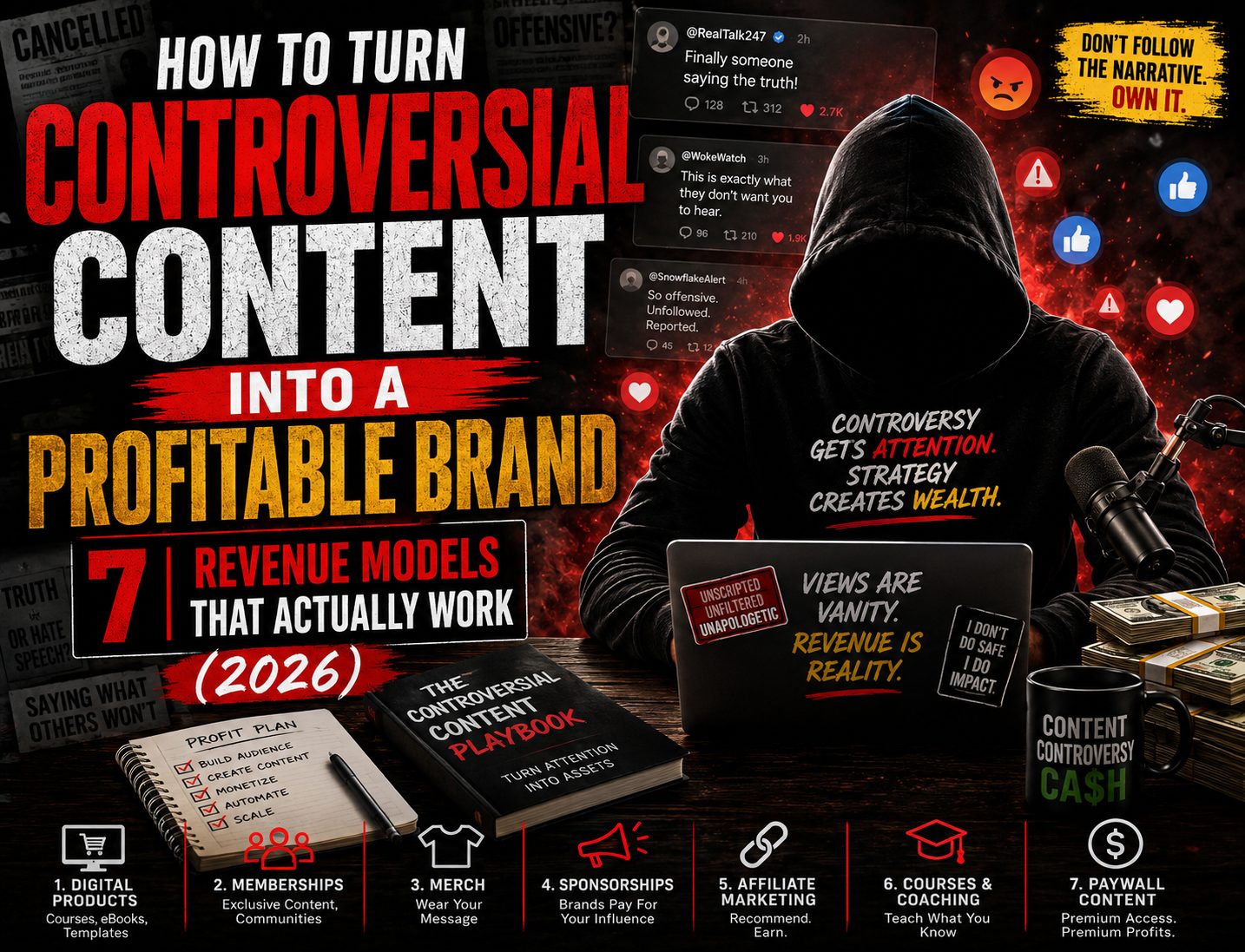
How to Turn Controversial Content Into a Profitable Brand: 7 Revenue Models That Actually Work (2026)

The short answer is yes—controversial content can become a profitable business, but only when it serves as the entry point to a larger strategy.
Controversy attracts attention. It starts conversations, generates shares, and encourages people to engage. Yet attention alone doesn’t build wealth. Every day, creators produce viral videos, trending tweets, and opinion pieces that receive millions of views, only to discover those views disappear as quickly as they arrived.
The creators building lasting businesses understand something different. They don’t monetize controversy. They monetize trust.
That distinction separates creators who experience brief moments of internet fame from publishers who build companies capable of generating income for years.
Whether your focus is hip hop, Black culture, politics, business, education, sports, or entertainment, the opportunity isn’t simply to capture attention. The opportunity is to transform that attention into products, services, intellectual property, and customer relationships that you own.
Key Takeaways
- Controversy is a marketing tool—not the product you ultimately sell.
- Sustainable media businesses generate revenue from multiple income streams instead of relying on advertising alone.
- Email subscribers, customers, and community members are significantly more valuable than social media followers.
- Products such as eBooks, merchandise, memberships, coaching, and consulting create recurring business opportunities long after an article is published.
- The creators who build wealth think like business owners instead of influencers.
Why This Matters in 2026
The internet has fundamentally changed how independent creators build businesses.
Traditional gatekeepers no longer control who gets published, who builds an audience, or who sells products. Independent websites, podcasts, newsletters, YouTube channels, and social media platforms have given creators direct access to millions of potential customers.
Yet that opportunity comes with a challenge.
Algorithms constantly change. Advertising revenue fluctuates. Social media platforms rise and fall. A creator who depends entirely on views or advertising places their business in someone else’s hands.
Ownership changes that equation. When readers subscribe to your newsletter, purchase your eBook, wear your merchandise, or hire you as a consultant, they become part of a business you control—not simply another statistic inside an algorithm.
That’s why today’s most successful creators are building media companies instead of chasing viral moments.
Why Controversial Content Still Works
Despite what critics often claim, controversy itself isn’t the problem.
Poor strategy is.
People naturally engage with conversations surrounding hip hop, politics, race, education, business, celebrity culture, technology, and social issues because these subjects affect their daily lives. Healthy disagreement encourages discussion, introduces new perspectives, and keeps important conversations alive.
The mistake many creators make is believing controversy is the destination.
It isn’t.
Controversy is the invitation.
Your expertise is the reason people stay.
The publishers creating long-term businesses use controversial topics to introduce audiences to thoughtful analysis rather than emotional outrage. Instead of asking readers to choose sides, they help readers understand the bigger picture. Controversial Content is the fire stick needed to get the eye balls on your products or services.
That approach builds credibility.
Credibility builds trust.
Trust creates customers.
The IsHipHopDead Attention-to-Ownership Model™
At IsHipHopDead, we believe every successful media business progresses through five distinct stages. Most creators master the first stage but never advance beyond it.
| Stage | Primary Objective | Business Outcome |
| Attention | Earn visibility through valuable content | Website traffic and audience growth |
| Trust | Publish consistent, evidence-based analysis | Returning readers |
| Community | Build email subscribers and loyal supporters | Audience ownership |
| Ownership | Sell products and professional services | Predictable revenue |
| Authority | Become the recognized expert in your niche | Long-term brand equity |
This framework changes the question every creator should ask.
Instead of asking:
“How do I make this article go viral?”
Ask:
“How does this article strengthen my business?”
That simple shift transforms content creation into business development.
Every article should move readers one step closer to becoming customers, subscribers, or advocates for your brand.
The Biggest Mistake Independent Creators Make with Controversial Content
Far too many creators spend years trying to become influencers.
A far better goal is becoming an owner.
Influence depends on platforms you don’t control. One algorithm update can reduce years of audience growth overnight.
Ownership is different.
Your website belongs to you.
Your email list belongs to you.
The intellectual property you create belongs to you.
Your books, courses, consulting services, and digital products belong to your company.
Every article you publish becomes another business asset capable of generating leads, building authority, and introducing new customers to your ecosystem. Content that is controversial leads people into a burning house that they can’t escape. They will keep coming back to learn more about you and the business.
That’s why successful publishers don’t ask, “How many views did this receive?”
They ask, “How many relationships did this create?”
The Seven Revenue Models Every Independent Publisher Should Consider with Controversial Content
The strongest media companies don’t rely on a single source of income. They combine multiple revenue streams that reinforce one another and increase customer lifetime value.
For creators covering hip hop, Black culture, politics, entertainment, entrepreneurship, and social issues, diversification isn’t optional—it’s one of the most effective ways to build a resilient business.
The seven revenue models that consistently produce long-term value are:
- eBooks
- Merchandise
- Premium newsletters
- Membership communities
- Coaching
- Consulting
- Podcast sponsorships and strategic partnerships
Each serves a different purpose, but together they create a business that isn’t dependent on one platform, one algorithm, or one viral story.
In Part 2, we’ll explore how to price these offers, compare today’s leading e-commerce platforms, examine the rise of social commerce, and outline a practical action plan that transforms readers into loyal customers while strengthening your brand for years to come.
How Should You Price Your Products and Services?
One of the fastest ways to sabotage a growing media business is by pricing products based solely on what competitors charge. Independent creators often undervalue their knowledge because digital products don’t have obvious manufacturing costs. In reality, readers aren’t paying for pages in an eBook or hours on a Zoom call—they’re paying for insight, experience, and solutions.
Think of your offers as a value ladder. Every product should naturally lead customers to the next level of engagement.
| Product | Recommended Starting Price | Purpose |
| eBook | $19–$49 | Introduce readers to your expertise |
| Merchandise | $30–$75 | Build community and brand visibility |
| Premium Newsletter | $8–$25/month | Recurring revenue and exclusive insights |
| Coaching | $150–$500/session | Personalized guidance |
| Consulting | $1,000–$10,000+ | Strategic solutions for businesses |
A reader who purchases a $29 eBook may later join your newsletter. A newsletter subscriber may purchase merchandise. A coaching client may eventually hire you for consulting. Each product strengthens the customer relationship while increasing lifetime value.
The objective isn’t to make one sale. It’s to build a business that continues creating opportunities long after the first purchase.
Which Selling Platform Makes the Most Sense?
Choosing where to sell is just as important as deciding what to sell. Each platform serves a different purpose within a modern creator business.
| Platform | Best For | Strengths | Limitations |
| Amazon | Books and print-on-demand | Massive audience, consumer trust, easy discovery | Limited customer ownership and increasing competition |
| Shopify | Brand-owned storefront | Complete control over branding, email marketing, and customer data | Requires consistent traffic generation |
| TikTok Shop | Social commerce and impulse buying | Strong viral potential and creator discovery | Sales depend heavily on platform algorithms |
| Alibaba | Manufacturing and product sourcing | Competitive wholesale pricing and custom merchandise | Not designed for direct retail sales |
For most independent publishers, Shopify should become the center of the business. It allows you to own customer relationships, collect email subscribers, and build a recognizable brand. Amazon expands your reach, TikTok Shop captures impulse purchases from short-form content, and Alibaba becomes valuable once demand justifies producing branded merchandise at scale.
Successful businesses rarely depend on one platform. They build an ecosystem where every channel supports a larger strategy.
Why Is Social Commerce Reshaping Online Business?
People no longer discover products only through search engines or television advertising. Increasingly, they buy from creators they already know, follow, and trust.
A thoughtful article about hip hop ownership, a podcast discussing entrepreneurship, or a video analyzing cultural trends can influence purchasing decisions far more effectively than a traditional advertisement. Readers want recommendations from people whose opinions they’ve come to respect.
For creators covering Black culture, entertainment, politics, or business, this shift represents a significant opportunity. Every article, newsletter, podcast, and social media post becomes part of a larger trust-building process.
Trust reduces buying hesitation.
Ownership creates recurring revenue.
This is why independent publishers who consistently provide meaningful analysis often outperform creators who rely exclusively on sensational headlines. Attention may earn the first click, but credibility earns the second, third, and tenth visit.
The IsHipHopDead Editorial
The creator economy has unintentionally convinced many people that visibility equals success.
It doesn’t.
Millions of followers can disappear with one algorithm change. Millions of page views can produce surprisingly little income if visitors never become customers.
The businesses most likely to survive the next decade won’t necessarily have the loudest voices. They’ll have the strongest relationships.
Independent media should stop measuring success by likes, shares, and impressions alone.
It should measure subscribers.
Repeat visitors.
The customers lifetime value.
Most importantly, measure ownership.
History consistently shows that the people who own the audience, the intellectual property, and the customer relationship capture the greatest long-term value. That’s true in music, publishing, technology, and increasingly, independent media.
Going viral should never be the finish line.
Building an asset should be.
IsHipHopDead Insight
Attention gets the click.
Trust earns the sale.
Ownership builds lasting wealth.
Every article should leave your audience smarter than they were before they arrived—and one step closer to becoming part of your community.
Action Checklist: Build a Media Business Instead of Chasing Virality
- Choose one niche where you can consistently provide informed analysis.
- Publish content that starts meaningful conversations instead of manufactured outrage.
- Build an email list from day one.
- Create your first digital product before worrying about advertising revenue.
- Launch branded merchandise that reflects your audience’s identity.
- Develop coaching or consulting offers based on your professional expertise.
- Diversify revenue across products, services, memberships, and sponsorships.
- Review analytics monthly to measure subscribers, conversions, and customer lifetime value—not just traffic.
Frequently Asked Questions
Can controversial content become a sustainable business?
Yes. Controversial content attracts attention, but sustainability comes from converting readers into subscribers, customers, and community members through products and services that deliver genuine value.
What is the most profitable revenue stream for independent creators?
Consulting and coaching often generate the highest profit margins because they require minimal overhead. Combining these services with scalable products such as eBooks and premium newsletters creates a more resilient business model.
Should I sell products on Shopify or Amazon?
Use Shopify as your primary storefront to own your customer relationships. Amazon works best as an additional discovery channel that introduces new readers to your brand.
Is blogging still profitable in 2026?
Absolutely. Blogging remains profitable when articles become the foundation of a broader business that includes email marketing, digital products, consulting, merchandise, podcasting, and community building.
How do I turn readers into paying customers?
Publish consistently, provide practical insights, build trust over time, and offer products that solve real problems. People rarely buy after one visit, but they often invest after repeated positive experiences with your content.
Final Thoughts
The future of independent publishing doesn’t belong to creators who generate the loudest headlines. It belongs to those who consistently produce ideas worth revisiting, conversations worth joining, and products worth buying. Controversial Content can be that bridge that brings it all together and make people beg to join everything you do.
For decades, hip hop has demonstrated the power of ownership—from independent labels and clothing brands to media companies and entrepreneurial ventures. Today’s creators have more tools than ever to build businesses without waiting for permission from traditional gatekeepers.
The challenge is no longer getting published.
The challenge is creating something valuable enough that people choose to support it.
If you’re ready to build a media company instead of simply chasing clicks, continue exploring the resources available on IsHipHopDead. Read our articles on starting a record label, understanding music publishing, strengthening urban education, and the evolving influence of hip hop culture. Visit our Shop for books and merchandise designed to help creators think beyond algorithms and toward ownership.
Because the creators who build lasting wealth aren’t remembered for one controversial post.
They’re remembered for the businesses they built after the conversation started.